How EDClass Addresses the Children’s Wellbeing and Schools Act 2026
The Children’s Wellbeing and Schools Act 2026
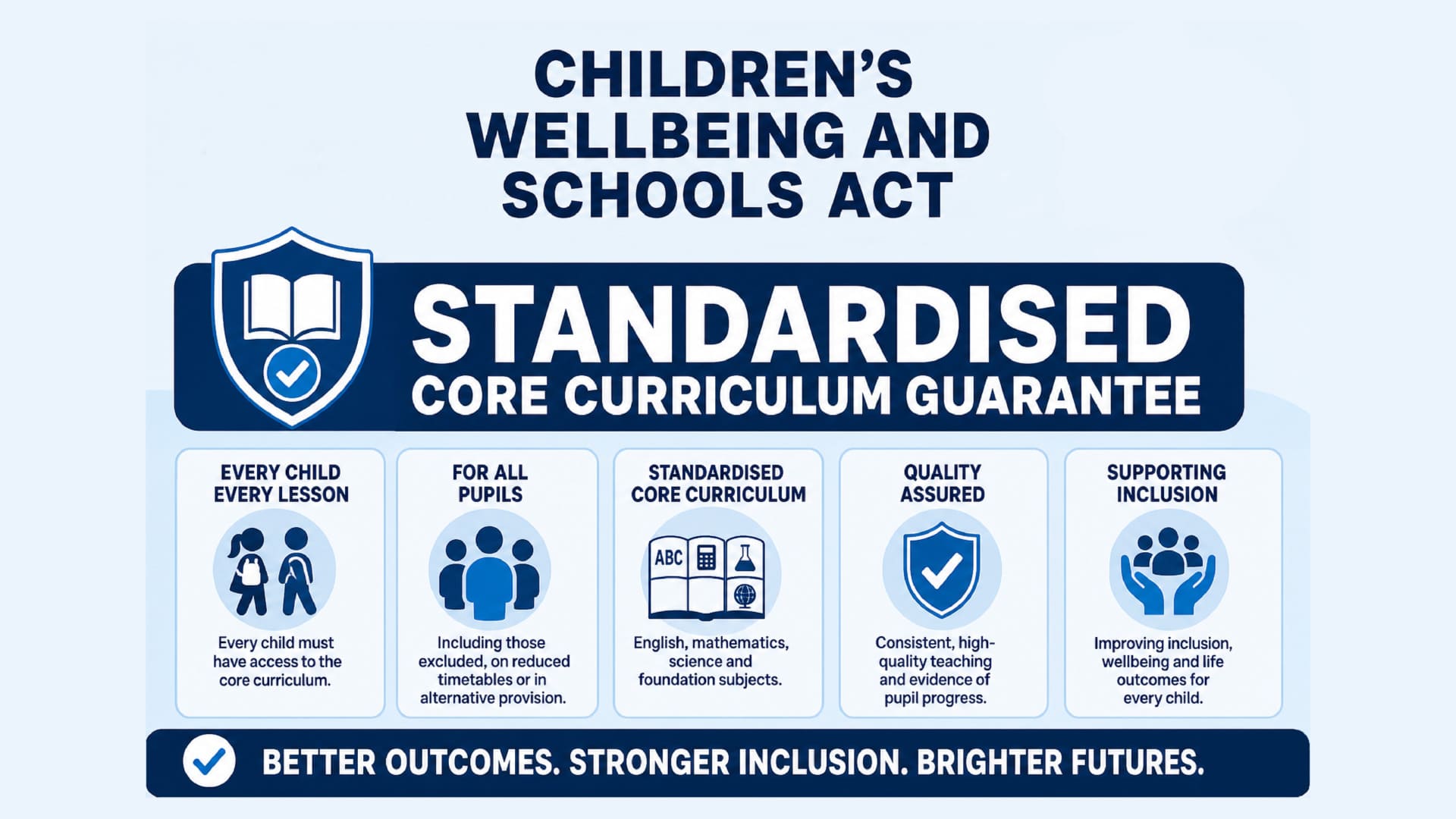
The Children’s Wellbeing and Schools Act 2026 places a statutory emphasis on child safeguarding, tracking children not in school (CNIS), and improving mental health and welfare support. The Act is more than a legislative update; it represents a fundamental shift in how the UK defines a ‘visible’ child.
For years, the gap between mainstream education, internal inclusion bases, and home-based learning was a blind spot where safeguarding risks could quietly escalate. With the statutory rollout of Children Not in School (CNIS) registers and the Single Unique Identifier (SUI), that blind spot is being systematically eliminated.
For Local Authorities, MAT Executives, and School Leaders, this heightened statutory oversight brings a critical challenge: How do we ensure 100% legal compliance and multi-agency visibility without drowning internal staff in administrative fatigue or compromising educational quality?
EDClass serves as the essential, DfE-accredited bridge – unifying digital learning toolkits with live teaching, live support, and live safeguarding to deliver total visibility across every setting.

The New Safeguarding Standard for CNIS Registers
Under the 2026 Act, simply having a child’s name listed on a register is no longer legally sufficient. Local Authorities and commissioning schools hold a statutory duty to ensure that children on CNIS registers receive a safe, active, and suitable education. To meet these rigorous standards, the following four pillars are mandatory:
It is no longer sufficient to assume a child is learning. Authorities need "eyes-on" proof of engagement to ensure the child is safe and present.
EDClass registers every login, active journey time, mouse interaction, and completed module. If a learner disengages or drops offline during a scheduled session, automated alerts notify the school, MAT, or LA instantly.
Safeguarding is about more than just academic progress. Providers must implement daily checks—such as digital wellbeing questionnaires—to catch early warning signs of neglect or harm.
Before entering core English, Maths, Science or other foundation lessons, pupils complete digital wellbeing check-ins. Emotionally dysregulated or anxious pupils are immediately routed to EDNurture for therapeutic support.
The Act emphasises "earlier intervention from social services." This is only possible if the people interacting with the child are trained to spot the subtle red flags that preceded cases like Sara Sharif’s.
All live teaching sessions and timetabled lessons, chats, EDInclude sessions and all interactions are overseen by Level 3 safeguarding-trained staff, Designated Safeguarding Leads (DSLs), and qualified educators who are safer-recruited and List 99/DBS checked.
With the SUI (Single Unique Identifier) being rolled out, safeguarding data must be able to move seamlessly between the education provider, health services, and social care.
Platform infrastructure is built for automated, error-free SUI data exchange, eliminating manual data entry for commissioning authorities.
Tracking Children Not in School (CNIS)
The Act introduces a statutory register for children not in school and gives Local Authorities (LAs) new powers to ensure children receive a suitable, safe education.
The platform provides comprehensive attendance and engagement monitoring. It records every login, session length, and lesson completed. If a student is absent or disengages, it immediately notifies the commissioning school or Local Authority, ensuring that no vulnerable child goes missing from education.
Safeguarding and Information Sharing
The Act promotes seamless, multi-agency collaboration and information sharing to safeguard children and ensure welfare concerns are acted upon swiftly.
- All live interactions within the EDClass platform are securely monitored and recorded. Designated Safeguarding Leads (DSLs) and LAs receive real-time data to assist with information-sharing duties. Furthermore, all EDClass teaching and support staff are List 99-checked, safer-recruited, and fully trained in child protection.
- Serves as an automated defensive perimeter (EDSafe). Real-time web filtering, active search monitoring, and welfare triggers automatically escalate alerts directly to the commissioning school's DSL and LA social care leads simultaneously.
Operationalising Statutory Exclusion and AP Guidance
In full alignment with statutory suspension guidance, EDClass allows schools to provision a virtual seat instantly. Suspended pupils log on from home or an inclusion hub to access live timetabled instruction, preventing learning loss and fulfilling statutory duties from hour one.
MATs can rotate a single virtual EDSeat dynamically across multiple pupils (e.g., Learner A on a morning part-time timetable, Learner B in afternoon internal inclusion, and Learner C off-site for medical re-engagement), maximising public resource efficiency.
Wellbeing, SEMH, and Nurture Support
The legislation emphasises early intervention for social, emotional, and mental health (SEMH) needs, addressing emotional-based school avoidance (EBSA).
- EDNurture: Offers targeted support and short-term interventions before core learning begins, helping students manage their emotional dysregulation.
- Proactive Wellbeing Checks: Provides a safe digital space where students can express emotions, complete safety questionnaires, and communicate with trained, empathetic staff.
- Flexible Engagement: Allows students to choose how they communicate (private chat, audio, or visual), which lowers anxiety and prevents students from being overwhelmed.
Ofsted’s Inclusion Framework and KCSIE Compliance
Ensuring that alternative provision, remote, and out-of-school settings adhere to rigorous, KCSIE-compliant supervision standards.
- EDClass incorporates strict safeguarding protocols. For live lessons, students must have their webcams and microphones active to ensure proper teacher supervision, welfare tracking, and adherence to safeguarding guidelines.
- Under its Online Education Accreditation Scheme (OEAS) accreditation, EDClass meets all national standards for safeguarding, curriculum breadth, and leadership quality.
On-Site Inclusion Bases (IAP) and Resourced Provisions
For schools running internal inclusion hubs, EDInclude and EDInclude+ provide instant, curriculum-aligned tasks with automatic marking. Internal staff focus on physical room management, reflection, and pastoral care while pupils receive continuous live support and diagnostic learning.
EDInclude+ layers direct on-camera specialist instruction and live screen-sharing over adaptive content, ensuring EHCP holders and high-need SEND pupils receive high-aspiring, tailored education in resourced provisions.
Why DfE Accreditation Matters
Not all online learning is created equal. A DfE-accredited provider has undergone rigorous inspection to prove they meet the highest standards of safeguarding, behavioural support, and academic rigor.
For a Local Authority trying to manage a brand-new CNIS register, an accredited provider acts as a guarantor of safety. It ensures that the "information sharing" mandated by the Act is handled by professionals who understand the legal threshold for intervention.
Empowerment, Not Interference: How Parents Benefit
For parents who have chosen Elective Home Education (EHE), these new laws can feel daunting. However, the Act actually offers a layer of protection and support for families who want the best for their children.
By using an accredited provider, parents have immediate, audit-ready proof that they are providing a suitable education, reducing the stress of Local Authority inspections.
Many EHE students have SEND or mental health challenges. These new measures encourage LAs to provide better resource allocation, ensuring home-educated children get the same support as those in classrooms.
The "duty to share information" means that if a family is in crisis, the system is designed to trigger support earlier, rather than waiting for a tragedy to occur.
How EDClass Makes Your Setting Operationally Ready
Core Statutory Mandate |
EDClass Operational Mechanism |
Strategic Outcome for Setting |
|---|---|---|
CNIS Visibility |
EDSafe real-time tracking and active study logging. |
100% attendance visibility; zero missing-in-education risks. |
SUI Integration |
Automated data pipeline export. |
Error-free multi-agency information sharing across Health, Social Care, and LAs. |
Day 1/6 Suspensions |
Immediate EDLive QTS streaming and EDInclude pathways. |
Full compliance with DfE exclusion guidance; zero dead-time learning. |
EBSA and SEMH Needs |
EDNurture therapeutic gateway and multi-modal chat. |
Reduced persistent absence; safe, step-by-step reintegration pathways. |
Inclusion Base Quality |
EDInclude+ adaptive diagnostics and automated marking |
Reduced staff administrative fatigue; calm, low-arousal behaviour repair. |
EDClass: Leading the Way in the New Legislative Era
As the landscape of UK education shifts toward total visibility, EDClass stands as the industry-leading provision designed specifically for this moment. We don’t just offer lessons; we offer a comprehensive safeguarding infrastructure.
The Children’s Wellbeing and Schools Act is a turning point. By partnering with a DfE-accredited, safety-first provider like EDClass, we can ensure that ‘visibility’ isn’t just a legal requirement – it’s a lifeline.
By utilising EDClass, schools and Local Authorities can meet the enhanced responsibilities of the Children’s Wellbeing Act with a centralised, fully-safeguarded digital system designed to protect, nurture, and educate vulnerable students.
Our platform is built to integrate with the new Single Unique Identifier, making the "duty to share" information an automated, error-free process for LAs.
Every student on EDClass is supported by real teachers and DSLs (Designated Safeguarding Leads) who provide the "eyes-on" contact the new Act demands.
Before a student even starts a math or English lesson, they engage with our wellness checks. We ensure no child falls through the cracks by making their wellbeing the prerequisite for their learning.
For children on the CNIS register, EDClass provides a structured, safe environment that respects the autonomy of home education while providing the statutory safety net required by the 2026 Act.